

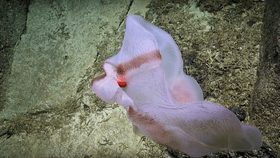
Animals that dwell deep in the sea do not have to maintain a single physical shape. The deepstaria enigmatica, for instance, can go from being a cute little floating bell-shape to spreading out like a vast, transluscent bed sheet. It is in no hurry to return to what it was. I have viewed a number of videos featuring this creature’s expansion and have yet to see it “go back to what it was before.” Just typing those words gave me chills much as watching videos of the deepstaria enigmatica do.
Every transformation I have sustained (all of them) started with those words— “I just want to go back to what I was before!” and ended with my forgetting I ever said them as I expanded into my nice new self. It is said that land animals don’t share the luxury of losing shape with their deep-sea brethren. On land, we stay the same. Or do we?
The words “ecstasy” and “hypostasis” suggest not. In ecstasy we feel ourselves move beyond the epidermal limit. We can feel much vaster than our frame. We can transcend shape just as the deepstaria enigmatica can. We might look the same on the outside. No one needs to know what we are experiencing on the inside. Archaic techniques of ecstasy, as Mircea Eliade entitles his book on Shamanism, share elements across cultures: stories, movements, collective archetypal journeys to an underworld, and rituals. Creative imagination connects them all: perception beyond the five senses heals us by facilitating this breaking-out of our shells. We let the soul inside go for a walk outside.
Hypostatic union is the theological term for Jesus Christ’s embodied duality of human and divine beings. They don’t merge. They don’t blur. They are distinct states. This is what makes him special. We, too, have the potential to be both through our creative imagination. When we alchemize experience using creative expression, we lose a little of our psychic corporeality and gain a little freedom. It feels like levity, like walking on air for a while. Then, we go back into the everyday world and bear it out until we can again pick up a pen or tell a story. The creative act renews us, and it facilitates our ongoing expansion beyond the material. As we age, the connections we can draw among our experiences can become more fascinating than taking on new experiences. We turn inward and find eternity within.
A few essays ago, I mentioned that the word “sublime” gets defined flippantly as “lofty” while its etymology denotes “up to the threshold.” This threshold is that between the corporeal and the spiritual. A person engaging the sublime stands at the meeting place between worlds. Doing so, scientific evidence shows, heals us through psychoneuroimmunology. Standing there for even a short spell yields benefits. Being able to stand there for prolonged periods, it has been noted, can yield what appear to be problems as the individual opens themself up to creative energy flowing in. Essays and books on “art and madness” abound. The film Dead Poets Society stands as much as a cautionary tale as an inspiring one regarding the transformative nature of poetry: shout it on the soccer field but don’t go letting Puck and the fairy world seize hold.
All of our ancestors once allows that creative realm to hold us. It connected us to one another through intution. It connected us also to the stars, the moon, the animals, all of nature. Without it, we would not be here. In only three hundred years without it in the West, save for brief strongholds of Fine Art, we’ve run ourselves into a very tight corner we don’t know how to get out of. True to form, we have invested into creating an artificial intelligence that augments our environmental crisis in order to solve our environmental crisis.
William Blake warned us about this, calling the world the West has engendered one of “single vision,” only the science, which is to say only the intellect. We left creative imagination behind. Double vision is our nature, seeing life in the way Robin Wall Kimmerer describes her Biology research and everyday life in Braiding Sweetgrass. Everything is both what its physical properties say it is and something limitless and meaningful. Everything changes within this framework. This framework does not change. Superposition is the sacred. Collapse is the damned. William Blake explains in the very famous passage, among the whole, The Marriage of Heaven and Hell,
“If the doors of perception were cleansed every thing would appear to man as it is, Infinite. For man has closed himself up, till he sees all things thro’ narrow chinks of his cavern.”
Once we have rurned our swords of existence into the ploughshares of stories, we see the depth of things. As with our sea creatures, in the depth things lose their shape. They merge and blend in the melted intellect now incapable of being divided from imagination. Here is the life of the waking dream. Here is the life of the resensitized adult experiencing the world through the eyes of the child. Such a person shapeshifts within in time with the shapeshifting universe within they move in. The more depth we cultivate through telling and exploring the depth of our stories, the less fixed everything appears to us. Telling melts linear reason into gooey, goopy associative reason, which is the kind of reason talked about in scripture and poetry.
Being of an associative mind renders us more compassionate than we would be if we only saw surface. Materialism isn’t an approach to life. It is the limitation of it. Life is what comes when the surface breaks, and we join the ranks of the wanderer. This wanderer sees all places as one place, hears all words as one word, encounters adversity as a matter of moving something around inside their own mind rather than pushing and prodding a world that, again, is one world within. Such a being is water. The word “hypostasis” speaks to this state. As hypoglycemia denotes not having enough blood sugar, hypostasis denotes not having enough shape. It is very close to metaphor, as being between shapes. When I look up “hypostasis,” I am instantly connected to theology. Jesus, being both man and god, is hypostatic.
Once again, removing the pomp and layers of interpretation, power-plays, power-grabs, and A.M. radio preachers in the Bible Belt, being Christ-like is being like Robin Wall Kimmerer and Bruce Lee and others who experience the full duality of the universe’s own hypostasy. Heaven is when we cruise in superposition. It’s the laid-back drive through the mountains that presents a dozen synchronicities with the entirety of life. It’s the signals comprised of bluebirds flittering about the kudzu. It’s the sudden impulse to tidy the house followed by the unexpected arrival of a grown child.
It’s the Zen and the Tao, the effortless effort and the least resistant path. It is seeing the world through the compassionate lens, the judgment beaten out through the years of working through the story. Once we know who we are, we hold who others are in less contempt, knowing what it takes to become kind—and the energy it takes to judge. Such a person also is sensitive because that is all our nature. Creativity and sensitivity go together. The former draws upon the latter, and it also cultivates it as perception. The latter relies on the former for sustenance, which is to say survival. Without Creativity, we have no means of processing trauma and emotional pain through the social and enteric nervous systems. It’s a body thing because it’s a life thing. It’s a body thing we’re growing back into after a time away.
“The work of the eyes is done. Go now and do the heart -work on the images imprisoned within you,” writes Rainer Maria Rilke. This cultivation of experience into story opens our inner-eye (third eye, eyes of the heart). A few pages in, and we start to see the sacred senses stirring. Something we write becomes something we hear somebody unexpectedly say. While we write, we feel we transport. We lose time, and time loses us. Like DaVinci’s Vitruvian Man and Michelangelo’s Adam and God on the Sistene ceiling, we can toggle between sacred and material states as imaginal and intellectual. We don’t have single vision by nature, only lack of nurture. Our natural state is both. We are destined to be hypostatic. We are remembering our depth.